

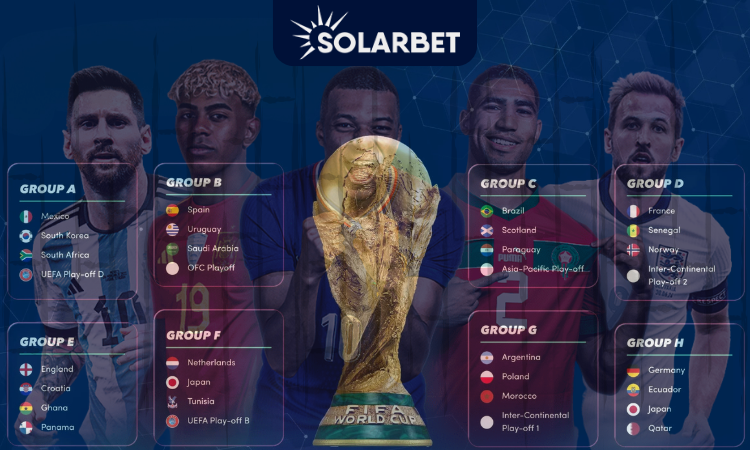
Forty-eight teams. Three countries. One tournament that’s about to look nothing like the one you grew up watching.
The 2026 FIFA World Cup isn’t just bigger — it’s structurally different in ways that will change which teams survive, how often upsets happen, and what the fan experience actually looks like. If you’re planning to follow it closely, or bet on it, the old mental model doesn’t apply anymore.
Here’s what the new format actually means.
48 Teams, But Not 48 Equal Chances: The New Group Structure
The previous 32-team format ran 8 groups of 4. The 2026 edition runs 12 groups of 3 teams each.
Each team plays only two group stage matches instead of three. The top two from each group advance automatically. Then the eight best third-place finishers across all 12 groups also advance — bringing the Round of 32 to 32 teams total.
This creates a dynamic that didn’t exist before: a single loss doesn’t eliminate you. A team can lose their opening match and still qualify as one of the better third-place sides if results elsewhere go their way.
What this means in practice:
- Teams are less likely to go all-out in a must-win second match knowing a draw might still be enough
- The “group of death” concept is less punishing — only one team per group is guaranteed to exit
- Fixture scheduling becomes critical, since teams only have two matches to build momentum before the knockouts
Will Match Quality Drop? What the Data from Expanded Tournaments Says
This is the legitimate concern about the 48-team format, and it’s worth addressing honestly.
FIFA expanded the Women’s World Cup from 24 to 32 teams in 2023. The tournament in Australia and New Zealand produced some of the highest-attended matches in Women’s World Cup history and several genuine upsets — but it also produced group stage matches with significant quality gaps between sides.
For the men’s tournament, the concern is similar. Expanding from 32 to 48 means 16 additional teams enter who would not have qualified under the previous system. Based on current FIFA rankings, several of those additional spots are likely to go to lower-ranked confederations where the qualification margin is thinner.
| Format | Teams | Group Matches per Team | Guaranteed Exits After Groups |
| 1998–2022 (32 teams) | 32 | 3 | 16 |
| 2026 onwards (48 teams) | 48 | 2 | 12 (+ 4 best 3rd place exit) |
The counterargument is that fewer guaranteed eliminations per group mean more competitive second matches — teams can’t be mathematically eliminated before Matchday 2, which historically produced some of the most passive football in the group stage.
Upset Probability: Does a Shorter Group Stage Help Smaller Teams?
Two matches instead of three is genuinely significant for lower-ranked teams. Here’s why.
In a 3-match group format, a team that upsets a stronger side in Matchday 1 still needs to sustain that level across two more matches. Physical depth, squad rotation, and tactical flexibility all become factors that typically favour higher-ranked teams over time.
With only two group matches, a single result carries more weight. One upset win can be enough to advance — especially under the third-place rule.
Real precedent exists. At the 2002 World Cup, Senegal’s run to the quarter-finals began with a group stage upset of defending champions France. Under the 2026 format, where only two group matches are played, teams like Senegal in 2002 would have needed only one more result to confirm advancement rather than managing a third high-pressure match.
This doesn’t mean upsets will be more frequent — but their consequences will be more immediate. A shock result in Matchday 1 of a 3-team group essentially determines the group before the final fixture is played.
Three Countries, 16 Venues: What the Host Spread Means for Fans
The 2026 World Cup is hosted across the United States, Canada, and Mexico — three countries, six time zones, and 16 stadiums.
Confirmed host cities include:
- USA: New York/New Jersey, Los Angeles, Dallas, San Francisco Bay Area, Miami, Seattle, Boston, Kansas City, Philadelphia, Atlanta
- Canada: Toronto, Vancouver
- Mexico: Mexico City, Guadalajara, Monterrey
For fans travelling to the tournament, this is the most logistically complex World Cup ever hosted. Group stage matches for a single team can be spread across different countries — meaning fans following one national team may need to cross borders between fixtures.
For those who can’t travel — which is most of the global audience — how to watch World Cup 2026 live becomes the central question. Broadcast rights are split by region, and streaming options vary significantly depending on where you’re based. In Singapore and Southeast Asia, rights for major tournaments are typically held by regional broadcasters, with streaming platforms carrying live match access.
What the Format Change Means If You’re Betting on It
The structural shift creates specific betting implications that didn’t apply in previous tournaments.
Key changes to factor in:
- Draw value increases in groups — with only two matches, a draw in Matchday 1 isn’t necessarily fatal. Teams may price in draws more tactically, making under 2.5 goals markets worth watching early in the group stage
- Third-place qualification adds complexity — live betting on group stage matches now requires tracking results across multiple simultaneous groups to understand third-place standings
- Upset windows are compressed — a lower-ranked team that leads after 60 minutes in Matchday 1 is potentially one result away from group stage qualification, which affects in-play odds significantly
For FIFA World Cup Live betting, the two-match group format means markets close faster and live odds shift more sharply on early results. Watching both group matches for context before the second matchday is essential for making informed in-play decisions.
Solarbet covers World Cup 2026 markets across all group stage fixtures, with live odds updated in real time as group standings shift.
The Fan Experience Question Nobody’s Asking
The expanded format adds 104 matches to the tournament schedule — up from 64 in the 32-team format. For broadcasters and streaming platforms, that means significantly more content. For casual fans, it means more matches to track simultaneously.
The best world cup betting sites in Singapore will need to cover all 104 fixtures with live markets — a meaningful operational difference from previous tournaments.
What doesn’t change: the knockout rounds still produce the same single-elimination tension. Once the group stage clears, a 48-team tournament converges into a Round of 32 that mirrors the intensity of any previous knockout stage.
The group stage got bigger. The stakes from the Round of 16 onward stayed exactly the same.
Don’t Depend On Size
Bigger doesn’t automatically mean better — but the 2026 format does create conditions where more teams have a genuine path to the knockouts, upsets carry immediate weight, and the viewing experience spans more time zones and more matches than any previous edition.
Whether that’s good for the tournament is still an open question. What’s clear is that following it closely — or betting on it — requires a different approach than the last edition.
Solarbet is where you go when you’re ready to back your read on it.
